Blog devoted to finding opportunities for profits in stock, bond, commodity, and currency markets by building a global macroeconomic outlook
About Me
- GlobalMacroSpeculator
- Trader, Sports Bettor, Poker Player
Thursday, November 8, 2012
Why PacWest Equities Inc Stock Is Ready To Collapse 95%
The issue is, once we have that profit its very tempting to continue to hold but the fact is that corrections from parabolic moves are usually vicious, fast. This is specially true in OTC stocks where instant fills are extremely hard to get specially during a panic The company is trading at about $2.16 pre-split with a market cap of about $1.2 billion dollars Infitialis and Michael Goode has both provided very solid fundamental reasons on why PWEI.PK (PWEID) stock is almost completely worthless
http://seekingalpha.com/article/927251-pacwest-equities-the-330-million-dollar-pink-sheet-with-no-cash-and-155-million-illegally-issued-shares-part-i
http://seekingalpha.com/article/982611-15-more-red-flags-for-pacwest-equities
I won't expand on that front because they did a great job. I don't even believe most shareholders care about the fundamentals of the company anyway. You have to understand that mindset of a OTC promo buyer "investor", this is all about a greater fool game specially when the stock has had a long period of increases. People are in just for another 10-20-30%, there don't care that the stock is completely worthless and the company has no real business. All one has to do is check places like IHub and see what kind of financial IQ most investors in the company have(Hint: Its not very high)
What they do care though is that the momentum game continues and they can get out at a profit before everyone else sells, this is the whole game here, selling before the other people sell. I'm going to present evidence on why PWEID is now close to reaching the point where everybody will head for the exit at the same time. Lets check some of the most successful stock promotions of all time and which price action lead to their collapse
One thing you can notice is that when prices goes parabolic this is usually a good time to sell NOT to buy, this is specially true when a stock promotion has been going on for longer than 1 month. At some point both the promoters and "investors" will want to take profits which leads to a cascade of sellers. What is also noticeable is that slow and steady price action can be followed by huge declines, this type of price action leads to complacency from investors who just buying counting on their "sure" gains till one day things reverse and everybody heads to the exit at the same time. PWEID has only has 1 decline in all its history(And it was a huge one). Volatility expansion is also a sign that the peak is near Lets look at PWEID action and see what can be inferred
Chart is adjusted for the split. You can notice that the stock had a long period of slow and steady action then went parabolic after the stock split on monday(When the stock rose about 40%), this is VERY worrying price action, I understand the longs will say "well its going up, its a good investment", truth is that everybody that is long is thinking like that and if they all try to sell and cash their profits at the same time they won't be able to because there won't be enough buyers.
Contrary to what the promoters say this stock is NOT heavily shorted because it is in Reg SHO, its very hard to get a borrow and short it, as a result once it collapses you won't have short covering rallies to any meaningful degree This promotion has been running now for about a month, successful promos don't usually run for much longer than that.
You can check old promos and see that after 1 month most of the gains have been realized and the stock faces a large wave of selling at some point
Furthermore the market cap of the stock is now over $1.2 Billion dollars(Once you factor in shares outstanding plus issued for acquisitions), this is probably the highest market cap for a pump and dump scheme of all time. High market caps act as resistance for the stock since it permits stock promoters and insiders of the company to sell worthless stock and realize a very large profit
Conclusion: PWEID now has gone parabolic and its volatility has expanded, judging by how this type of price action has been met with selling(Usually large and quick selling) most of PWEID gains look like they have been realized.
The greater fool game is now coming to a point where the people will actually have to face the fact that virtually everybody knows that this company is fundamentally worthless and they will all try to sell at the same time, whether they will be able to is another question but history has not been kind to this type of speculative game.
The complacency of investors due to the slow and steady action combined with large quick gains will only feed into the selling because that kind of action draws a lot of people into playing the momentum game but at some point everybody will try to realize their gains and the stock won't have enough short sellers and true fundamental investors to bid for the stock once it collapses. The correction is likely to be vicious and fast
Thursday, May 3, 2012
Why the EUR is likely to go bellow parity with the USD
Some people asked me why short EUR, my hunch was that the panic there would lead to capital outflows. Let me articulate a bit better
Lets say Greece drops out of EUR, depositors and people who hold financial assets(Lets call them DC Devalued Citizens) will face an overnight loss of something like 60% in their wealth. Non-devalued citizens(ND) will begin to wonder about their own wealth
ND with assets in countries with high spreads over bunds will begin to fear for their own wealth, the correlation between fears and people moving out of their assets from those countries will rise. They will do the following things most of the time:
-Buy EUR denominated debt or deposit it in 'safer' countries
-Buy USD
-Buy real assets
But my bet is that when an actual departure from the EUR occurs the level of panic in the high spread countries will be so high that German yields will be driven to absurdly low levels(They are already quite absurdly low). Their real interest rates will collapse for many years out the curve. Low real interest rates will be so bad relative to the US that it will drive flows to the USD. Effectively the people there will be enacting many rate cuts, that is usually bad for the currency
But there are other effects, when a country leaves they are also defaulting in loans by paying in a devalued currency so the banks of other countries who hold those debts will face losses. This means that the pool of 'safe' countries that ND can invest their EUR wealth will decrease(As they have to bail out their banks and people fear that the banks are not safe, perhaps France will be in this category) when the amount of countries where there is a risk(even if the risk is small) will increase. This will only encourage the capital flows to go towards the USD and Real Assets(Will also compress the yields in the remaining safe countries even further)
When the first country leaves and people see the loss for the DC, having money in EUR will be like being in a mine field where you don't know where the mines are. There is a haven(Germany) but if everyone piles up on the same place its valuation looks worse and worse. This would be excellent for USD and gold
To me this mine field analogy is the real killer. IME people totally hate to lay odds in bets, everyone wants to bet getting 6-1 on their money not offer 6 for everyone 1 that is bet.
Having EUR on a country that can devalue will be effectively laying odds on your wealth. You can lose a lot to make a little. This is also why there are excess returns in stocks that have uncertainties in them, they are sold to levels bellow their fair value because people hate a small gain if there is a significant chance of a large loss
This analogy does not apply to extremes, people will lay 100-1 if the chance of the large loss is really small, they will pick pennies in front of a truck sometimes. But the fact that they just saw a devaluation will change things, because now they will be afraid and will increase the probabilities in their minds of the large loss
I believe even the market agrees with my view. Back when Greece was threatening a EUR referendum and full default the EUR dropped 500bps in a few days. Its a matter of what the probability is, the market thinks its small so they keep the currency at the current level. I believe its much higher so I'm short and I expect it to collapse bellow parity IF I'm correct some countries will leave
Other interesting ways to play this trade
-Buy black swan type long-term puts on EUR
-Short right after a country leaves, the currency will probably be down a lot that day, if feels un-natural to 'chase' the trade. But just imagine the people with huge EUR portfolios who now might want to liquidate. For them as a whole its going to take many days if not much longer
-GlobalMacroSpeculator
Wednesday, February 16, 2011
Recommended books for the New Global Macro Trader
The first 2 are written by a mathematician while he is not involved in the financial markets(He is a gambling expert), those are excellent works on HOW TO THINK. He helps you understand common logical fallacies people tend to commit, he also points out how probabilistic thinking works.
Probabilities are a important area of any serious trading plan and a good trader needs to be educated on that. Furthermore the parallels between gambling(And beating the house) and trading are quite big. Contrary to popular belief it IS possible to beat casinos but that can only be done in certain games, during certain periods with large amounts of study and discipline(Like in the markets). The first book is a required reading at Susquehanna
The last 2 are books of interviews with macro traders, they help you understand the thought process of a macro trader, how to come up with ideas for trades, do research, manage risk,etc. Its ironic given that the crisis and its aftermath have bankrupted or lead to the effective failure some of the traders interviewed(Siva-Jothy, Peter Thiel, Anderson), nevertheless lessons can be drawn from their failure as well.


The last one is a bit controversial because its written by a trader who made millions but went broke twice. Despite his failures Victor Niederhoffer is a knowledgeable guy and his statistical approach to the markets is a key part of trading based on evidence as opposed to guesses or faith, he is very good at "myth busting"(Debunking common held belifs about money making opportunities in markets and showing what actually works)
Furthermore his failures give an invaluable lesson with regards to position sizing(When in doubt be conservative)

Friday, June 26, 2009
Credit Crunch
"However, this strong economic growth was not to last. As the 1980s came to an end, the US economy slowed dramatically, and by the early 1990s tipped into recession. To make matters worse, the banking system was in turmoil, with hundreds of small and medium-sized banks failing and giants like Citibank and Chase Manhatten in distress. Meanwhile, the real estate boom had collapsed, causing even more pain."
"The inevitable collapse of the real estate boom really shook the banks. Uncertainty about the value of the real estate collateral securing their loans made bankers unsure how much capital they actually had—leaving many of them paralyzed, frightened, and reluctant to lend further. Big businesses were able to tap other sources of funds, such as innovative debt markets that had sprung up on Wall Street—(note: this is likely to be securitization and shawdow banking)a phenomenon that helped keep the 1990 recession shallow. But small and midsize manufacturers and mer-chants all over America were finding it hard to get even routine business loans approved. And that, in turn, made the recession unusually difficult to snap out of. "
"Nothing we did at the Fed seemed to work. We'd begun easing interest rates well before the recession hit, but the economy had stopped responding. Even though we lowered the fed funds rate no fewer than 23 times in the three-year period between July 1989 and July 1992, the recovery was one of the most sluggish on record. I would see President George Bush every six or seven weeks, usually in the context of a meeting with others but sometimes one-on-one. Before long, the administration began blaming its troubles on the Fed. Supposedly we were choking the economy by keeping the money supply too tight."
"When the recession hit that fall, the friction only got worse. 'There has been too much pessimism,' President Bush declared in his 1991 State of the Union address. 'Sound banks should be making sound loans now, and interest rates should be lower, now.'"
So the last credit crunch the US has had was saved by a new high in the US credit bubble made through securitization and shadow banking. This time the game is up, the Fed Senion Loan Officer survey still shows bank loan standards are being tightned across the board a weak jobless recovery looks like a likely outcome. The unemployment rate went up almost 1% after the last 2 recessions were declared over. It looks likely the current one will see unemployment reach 11%
Monday, June 22, 2009
Stock Market Volume
I'm as bearish as a number of other people in the US stock market however one of all the arguments for 'this is a bear market rally' I'm not sure the 'low volume in the rally' is a good one, the market just came from a period where everybody thought things were going to $0, the market was trading in a economic depression type enviroment so it was expected that volume would shoot at absurd levels. As the depression is priced off the market is natural that volume would decrease, there's nothing unhealthy about this, its only unhealhy if you are looking at volume moving averages that are still capturing the Lehman crisis Sep08-Mar09 volume levels
Its almost impossible to beat that kind of volume without another massive failure so some bears are creating an strawman in order to support their cases. The current volume levels is still right in line with the pre-lehman 2008 levels so it could be a more neutralish technical point than some realize
Thursday, June 18, 2009
XLF
Friday, June 12, 2009
The Mailman Drop of Money - You've got Money
We hear a lot about helicopters dropping money from the sky in order to beat deflation, that kind of plan is not likely to be ever adopted since it would be unfair to all citizens not in the cities that is getting the cash rain, further more no government body(to my knowledge) has the authority to take such action. However the IRS has a paper check mailing authority that can and is likely to be used in the case deflation in the core CPI becomes a reality and is persistent.
Here's how it would work, the administration working with congress would receive a advice from the Fed chairman to go ahead and issue a tax cut to virtually all citizens for an gigantic amount(Say 50% of US consumer spending, $5T), the fed would stand behind the bond auctions and monetize to make sure the government would have no problem financing it. The US consumer would suffer an gitantic 'wealth effect' of receiving such windfall gains in networth and its very likely to spend a significant fraction of the tax cut(as the history of the wealth effect shows, people spend when they get big jumps in networth)
Immediately as those paper checks were deposited, the money supply would soar(checking accounts are a component of M1), total M1 as 04/2009 is $1.5T, that would jump to $6.5T(Which would be the largest jump in M1 in the history of the United States). Now keep in mind that no banking credit expansion would be necessary for this. To the extend that people spent some of that money(and there is no reason to expect that cash to have 0 velocity due the wealth effect and the fact that people spend some % of tax cuts) that would put A LOT of upward pressure on prices, we are talking an overnight huge jump in the money supply AND velocity, even if that didnt happen nothing prevents them from keep increasing the amount of money printed. They could print 1 quadrillion dollars if necessary, talk about wealth effect
In the meantime the banking system can be frozen and yet inflation on the moon. If you read the american central bank literature of the last decade there is simply no reason to expect Bernanke and Co to not go for these extreme plans in order to beat deflation, they already said they will if necessary.
Actually just the announcement of such intentions by the Fed chairmain is likely to send the dollar index plunging and everyone scared of inflation(therefore money velocity would rise), its possible that not a single check needs to be mailed
As of right now, there is no reason for the fed to take such action as the core inflation rate is in their comfort zone, inflation expectations are well anchored and the economy is showing signs of stabilization. But make no mistake, if those improvements reverse one of the easiest money fed chairman since Arthur Burns + politicians desire to spend without raising taxes(It shouldn't be too hard to convience congress and Obama that more stimulus is needed, specially with unemployment about 10%) and the IRS mailman drop of money(or direct deposits to bank accounts) virtually guarantees US deflation wont be here to stay(Or it would be cured naturally as the economy bottoms out)
That might not be the case in europe where deflation could be persistent as the ECB is not as extreme(plus they don't have a centralized mailman to send checks, they would have to pick a government and all sorts of problems could occur) they also have the German hyperinflation history which further creates political problems and criticism and certainly is not the case with the BOJ, which is run by incompetents who never tried extreme measures to reverse deflation and raise the money supply without depending on the banking system
Monday, June 8, 2009
Putting a price on the green lunch
Well, according to the stock market more than $4T dollars. Market cap of the Whilshire 5000 in the march lows day $9.38T, market cap today $13.4T. Given the total US corporate profits(including non-publicly traded corporations) was $1.2T in 2008
, the market decided that when economic data stops accelerating the rate of contraction that is worth putting a additional 4x profit multiple over it. It was a about an 43% rally, did the green shoot story overshoot?It looks like so since a 2nd derivative doesnt tell you anything about WHEN a bottom is coming, it just tells you that there is one. The green shooters have a $4T gamble going on, time will tell whether they paid the right price for their optimism
Wednesday, June 3, 2009
Inflation
Krugman seems to be in the camp that deflation is inevitable, there is nothing that can be done and people shouldn't be worried about inflation.
Here's how the fed can create tons of inflation. Working with the treasury they announce a broad tax cut of $20T for all US citizens, it would financed by creation of new money by the Federal Reserve, this would bypass the banking system need to expand credit.
If people save 80% of that, they would still spend $4T. US consumer spending would rise by about 40% very quickly and tons of new money would flood the economy. This wouldn't create just inflation, hyperinflation would likely to be the result. The fed is not going there just yet(and they shouldn't) since the core CPI and inflation expectations are still within the Fed's range but if things fell out of bed you can count on the fed to make everybody to pay more for goods and services.
And to the extend that markets are forward looking people SHOULD be worried about inflation at some point over the next years as the fed suffers from an asymmetrical dilemma, where inflation is bad but deflation much worse therefore they will like to err in the side of the former
To argue otherwise is to ignore most of the american central bank literature of the last few decades where they make it clear they wont tolerate deflation and a frozen financial system wont prevent them from meeting their objectives.
Friday, May 29, 2009
Shawdow Banks
Til Schuermann a member of the Federal Reserve Bank of New York testified before congress and he made some scary remarks. It's a highly recommended reading
"When one adds credit provision though corporate bonds and commercial paper, one realizes that commercial banks have provided only about 20% of total U.S. lending, since the early 90s. The four decades prior had banks’ share closer to 40%. The rise of market-based instead of bank-based credit provision in the last twenty years has been substantial and important."
Bernanke was using misleading numbers about a 50% share a few months ago, I assumed his figure was correct. I first saw the 20% in the Economist a few weeks back, the FRBNY now is backing this. With the shadow banking system now in its grave(the commercial banks still zombified) plus market lending still weak(although enjoy a nice temporary rebound) this spells big trouble for future credit growth and US potential GDP. The stock market is almost surely being delusional if they expect the type of corporate profit margins the US had in 2007 to return, if anything they will continue to shrink. 2010 GDP which is forecast to be around 2-3% is also almost surely too optimistic with the current levels of credit growth and household stress
Monday, May 25, 2009
Friday, May 22, 2009
US Consumer
"Recession Turns Malls Into Ghost Towns" - WSJ
Gap Profit Falls as Consumers Trim Clothing Purchases
This week ICSC-Goldman Store Sales posted a 1.2% decline W-W
Redbook reported -0.2% in store sales from Apr to May
Wednesday, May 20, 2009
Japan GDP
What are the odds that the worst GDP report ever is followed by a V type recovery as it seems to be currently embedded in Japanese equity values?(Or at least expectations that another L wont occur)
Here's some analyst comments from the worst report ever
"We’ve turned the corner. The economy is no longer in free fall"
“The worst is over,” said Hiromichi Shirakawa, chief economist at Credit Suisse Group AG in Tokyo. “We’re going to see positive growth -- not significant growth, but growth --from the second quarter onward.”
They usually justify the optimism by hand picking data that is bouncing around
It just seems that the odds that people are engaging in wishful thinking is much greater than the odds of a actual V recovery after collapses of this magnitude(specially when needed reforms are still lacking), maybe wishful thinking is as much as 8-1 favorite to be taking place than the theory that an actual V type recovery is happening
I've been hearing a lot of 'inventory' recovery in the 2nd half following inventory drawdowns in the US and countries. That is totally wrong, inventories are down but SALES are down even more
As sales reset to a new level so does inventories, who is going to rebuild invetories when you can't sell anything?
Monday, May 18, 2009
Hussman Watch
John Hussman Watch
Hussman lastest article looks mostly correct with the exception of when he addresses the idea of pundits referring to consumers increasing their savings as being bad to the economy
He says
"At present, it is not valid to say that the economy is weak because people are saving too much, because if gross savings were up, gross investment would also be up."
Well the problem is that when pundits say 'people' are saving too much they refer to US consumers and to some extend to the corporate sector not to "gross domestic savings"(that is, total saving including consumer, corporate and government entities) that Hussman is addressing, in fact one of the arguments of the pro-stimulus people is that since consumers are saving more its up to the government to borrow and spend so to keep gross domestic saving from collapsing national income(Like in the example he outlined)
So yes he is right that gross domestic savings is not rising(Mainly due the government deficit) but its not rising because left to its own devices it would have risen and the government decided to try to cushion its impact by increasing government investment(thus lowering government saving) by running deficits and through the stimulus plan, so the pundits are wrong from a nit picky English perspective but their main point still stands, a rise in consumer saving in a macro level while desirable in the long-run is not its good for the economy at all when it happens in a major way very quickly, if uncontrolled it would lead the US into a deep depression, yes savings equals investment but only because 'investment' includes inventories, so if everybody stopped buying from wall-mart tomorrow the rise in WMT inventories would show up as 'investment' even though WMT had no intention on increasing investment, in fact its just the opposite they will cut jobs, stop expanding till they see a pickup in sales(Hussman acknowledges this by saying "Output that is not consumed represents 'investment' even if it is unintentional 'inventory investment.' ")
This article from Wikipedia nails it
Savings Identity
"Note that this is an "identity", meaning it is true by definition. This identity only holds true because investment here is defined as including inventories. Thus, should consumers decide to save more, and spend less, the fall in demand would lead to an increase in business inventories. The change in inventories brings savings and investment into balance without any intention by business to increase investment.[2]
Note, that as such, this does not imply that an increase in savings must lead directly to an increase in investment. Indeed, business may respond to increased inventories by decreasing both output and intended investment. Likewise, this reduction in output by business will reduce incomes, forcing an unintended reduction in savings. Even if the end result of this process is ultimately a lower level of investment, it will nonetheless remain true at any given point in time that the S=I identity holds"
Therefore Hussman setup a bit of a straw man and is nit picking pundits and analysts because when they say a 'this rise in savings is hurting the economy' they do not mean 'gross domestic saving'(Which is affected by government deficits and investment) but they refer to consumer and business saving(that is gross domestic private saving), which a major quick rise in a macro level would result in a economy much weaker than otherwise(The so called Paradox of Thrift)
Friday, May 15, 2009
More DA
Credit Markets are healing and opening up for business. Credit Research indices of credit spreads are improving across the board
Could the market be engaging in wishful thinking and be ready for another blow out of spreads?Sure but this healing creates a self-fufilling propechy(What George Soros calls 'reflexivity'), the improvement in risk taking increases the amount of credit avaliable to economic agents which raises the chances they will make it without going through bankruptcy, it also lowers their cost of credit increasing their profitability which also raises their odds of survival. As Bill Ackman put it if everybody was a pessimist like Roubini the economy would die of a horrible death. If instead everyone just turned into a Pollyana the economy would perform much better than otherwise, thats why badly designed stimulus packages are not such a bad idea, quasi placebos can be a powerful thing
Thursday, May 14, 2009
Devils Advocate
Since my current macro thesis calls for lower equity prices(particularly in financials, reits and other leveraged garbage companies) I thought about making some counter arguments against a bearish view in stocks and the US economy
1 - The Yield Curve is suggesting recovery. People who ignore the Yield Curve are usually wrong
YieldCurve
2- Housing Affordability is reaching generational levels
Some housing experts believe that a particular level of home prices is not what drives demand but actually housing cost against income, with mortgage rates so low AND prices dropping affordability is rising. Perhaps Case Shiller will surprise everyone by bottoming earlier
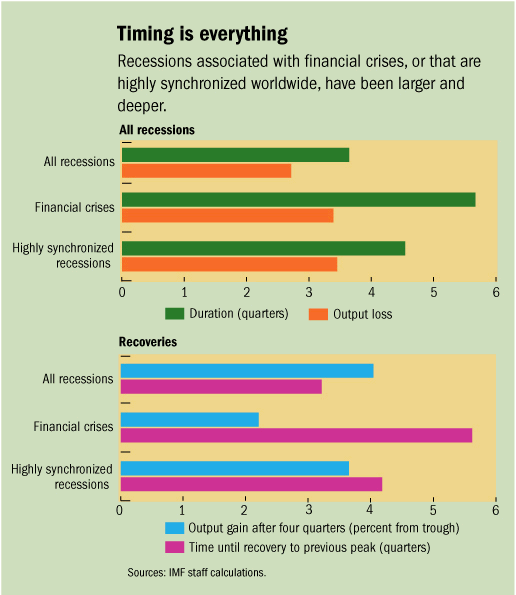
3 - IMF Research on Financial Crisis suggest financial crisis recessions last 5.5 quarters on average and syncronized recessions last 4.5 quarters on average. So far this US recession has lasted a little more than 5 quarters so a bottom could be around the corner
4- Private Banks might not be lending a lot but the US government is taking over the role of a lender(The so called Minsky Solution). TALF, fed facilities(like the Commercial Paper facility) are substituting the private sector and helping support credit. Those programs can surprise on the upside by getting more traction, in fact TALF for CMBS could start a big bailout of REITs and prevent GGP type failures
5 - US stocks already went down by 60% or so from peak to through its silly to keep pounding on the same bearish thesis as the risk reward is getting terrible and risk premiums and projected returns are rising. Experienced short sellers such as Jim Chanos follow this disciplined approach, he is out of short selling financials and beaten down sectors due a 'asymetrical risk reward relationship' he says he will let 'others pick up the last $10 a share'. There is a lot of wisdom behind this theory, in fact its pounding on the same thesis what destroyed Citigroup, Bear Sterns, Boone Pickens, Dwight Anderson, Tech Stock investors, others. In fact when you have markets going one way or the other in a straight line at turning points a lot of people will go broke because its natural to look at the 'fundamentals' in a very biased way when you have huge profits. People will make up excuses to stay in the trade
Tuesday, May 12, 2009
Greenshooters Sheet
The Stress Test seems to be using a slighly worse forecast than 'the blue chip' consensus. A few points
-If the Blue Chips forecast for 91-day T-Bill rates plays out, that implies a federal funds rate at 2.5-3% by 2011, this would hurt bank margins and earnings. It's very likely this fact wasn't factored in the stress test as the Treasury seems to think all banks problems will be magically over by december 2010
-Its May and the unemployment rate already matched the blue chip forecast for the entire 2009
-They all expect 10 Year US Treasuries to be around 5% from 2013 to 2019, this seems like a joke, its very likely its going to be one extreme or the other, either the US becames japan and the ten year trades around 2% for a long time or it gets out of this problem with inflation and fiscal issues(including the severe entitlement problem) and rates soar
The stock market own forecast is probably a mix of those above, it clearly doesn't expect the stress test 'more adverse' scenario to occur otherwise banks would have no earnings(They would post a more than $200b net loss) and the XLF would nosedive. Consensus is usually too bullish, especially when massive bubbles burst, when the market realizes that the more adverse scenario is actually the baseline things will get ugly
Friday, May 8, 2009
Bernanke The Bank Analyst
The stress test result is out showing that is expected that banks will lose $600b against $362.9b in pre-tax pre-provision income(What the feds call pre-provision net revenue, PPNR), this is a $237.1B in net losses for the US 19 largest banks
Of all the banks tests only three show they will have a net gain over the next two years, Goldman with a whopping $0.7B gain($17.8B losses against $18.5B in PPNR), Bank of New York Mellon with a gain of $1.3B, Amex with a gain of $0.7B
Now keep in mind that the PPNR uses the management estimates of what they will likely earn, this is almost certainly too optimistic as anything that depends on a CEO judgement usually is. It also uses the Treasury economic forecast that will likely prove too optimistic as well(Unemployment is likely to top at 11%). But even then, forget Meredith Whitney, the fed just launched their own earnings forecast for Bank Stocks
over the next 2 years, virtually all of them will show a netloss, some of them will need additional capital and dillute shareholders as their rosy scenarios dont playout. If you look at anlysts earnings estimates they painting a much more optimistic forecast and the stock market is putting something like a 10 multiple on those rosy forecasts, what happens when the market realizes the economy wont grow at 2% rate in 2010 and there will be no earnings and more dillution coming?
What we are seeing in banks stocks is one of the biggest suckers rally ever
Wednesday, May 6, 2009
Bernanke Not Smoking Yet
"We continue to expect economic activity to bottom out, then to turn up later this year....An important caveat is that our forecast assumes continuing gradual repair of the financial system; a relapse in financial conditions would be a significant drag on economic activity and could cause the incipient recovery to stall"
"Investors seemed to adopt a more positive outlook on the condition of financial institutions after several large banks reported profits in the first quarter, but readings from the credit default swap market and other indicators show that substantial concerns about the banking industry remain."
Bernanke's concern arises from his own research published in a paper and his book about the great depression. He found significant statistical correlation between banking panics in the 1930's and collapses in industrial production and economic activity
Most of the Q1 earnings were either one-time items(like mortgage refis or capital gains from holding GSE debt), volatile hedge fund type profits('trading' revenues), gains from declines in the bank own debt or write-ups from bad assets using rosy assumptions. It doesnt take a genius to realize that a quarter where GDP went down 6% and unemployment jumped shouldn't bring out profits to businesses that are simply levered bets in the US economy
With home prices still in decline and unemployment headed higher its very likely bank earnings will dissapoint the now optimistic forecasts, beating Q2 estimates will be much more difficult because everyone is now passing the green shoot bong and optimistic expectations are setting their own downfall
Looks like BAC needs $30b+ in capital, C $10b and 8 other banks also need money. Keep in mind that this is using the government rosy assumptions about unemployment and accepting bank management rosy assumptions about pre-tax pre-provision earnings, plug-in more realistic numbers and the capital needs would certaintly soar. This suggests Bernanke's fears might became reality as the market will grow its concerns about bank capital and earnings in the coming months. The XLF has lead this market all the way down, unless housing and the labor market turns around its quite likely this will happen again
Monday, May 4, 2009
Buffett The Zombie King
Apparently Buffett believes in Madoff banking, he wants the government allowing banks to 'earn' their way out of the problem even if they are insolvent. He said sometime ago he feared the 'government forcing banks to issue stock at very low prices, they can earn their way out of this mess', he is the US zombie banking commander in-chief. For him its not a big deal for the banks to be be critically undercapitalized in a tangible common equity basis(like Wells Fargo) as a long bankers get a chance of to hit again after one of the biggest strike threes in the century. Although its an extreme comparison it resembles the idea of allowing Madoff to keep his company as a going concern and hand him taxpayer subsidies so he can try to 'earn his way' out his hole playing futures
Whats the problem with this approach? Banks wont lend, the latest Fed report on banking lending shows that net credit is down again, the truth is that banks need to be massively overcapitalized(preferably through preferred stock/unsecured debt to equity swaps while respecting property rights)right now so they can feel safe lending again and they can stop using the FDIC deposit and bond guarantees for funding. Banks uncertain about capital will fear their regulators and hurt the lending markets
Buffett claims WFC is a fabulous bank and he would put his entire net worth there I disagree the plain fact is that lots of wells advantages comes from federal subsidies. First the bank is too big to fail, most of the banks with more than $10b in assets pay less in interest for their deposits even though their banking portfolios are worse than smaller banks(Source: FDIC quarterly banking profile). This is the US depositor betting the bigger banks will be saved. Secondly the federal funds rate is at 0% while lending rates are high, this federal subsidy is not sustainable it will reverse eventually, the 'margins' that buffett mentions as one of the great banking assets will decrease at some point. This is a transfer of wealth from savers to banking shareholders, when the economy recovers and banks puts their balance sheet issues behind them they will face as earning issues as the fed raises the rate and banks face massive regulations(along with lower lending rates). Plus there are the FDIC guarantee programs that almost certainly charge a price that misprices its risks(given that they need a bailout themselves), so its a subsidy
Thidly, Obama needled Buffett when the oracle suggested banks shouldn't be forced to issue stock to raise capital 'at very low prices', he said something like 'Buffett is a large player in the financial markets, he is a big shareholder of wells' suggesting he will do the right thing and make banks issue stock and de-zombify them
And finally, there is very little hope banking stocks are something to get excited for the next 10 years
Greater regulation, higher capital ratios(Alan Greenspan is suggesting 15% capital) and a less levered weak growth economy will almost surely hit US banks ROE and therefore stock returns going forward. So perhaps Wells will beat its bank index benchmarks because its a bank that seems to exploit the tendency to get subsidies from the government better than its competition but that doesn’t mean its something to get excited about, it certainly means you wont put a significant part of your networth there due uncertainties, specially with nationalization risk on the table(Maybe Wells Fargo, the company, survives but its possible WFC, the stock, gets destroyed in the process) this is a particulay worry in a undercapitalized bank like wells facing the fat tail risk of 12-14% unemployment
Of course Buffett would object to this saying you cant predict macro/regulatory/economic events, nonsense. Its amazing how someone who makes fun of the efficient market hypothesis turns into a EMH himself when confronted with examples of people predicting macro events for a long time